Operating Architecture™
The discipline of designing how every part of a business works together to convert market demand into sustainable cash flow, enterprise value, and shareholder returns.
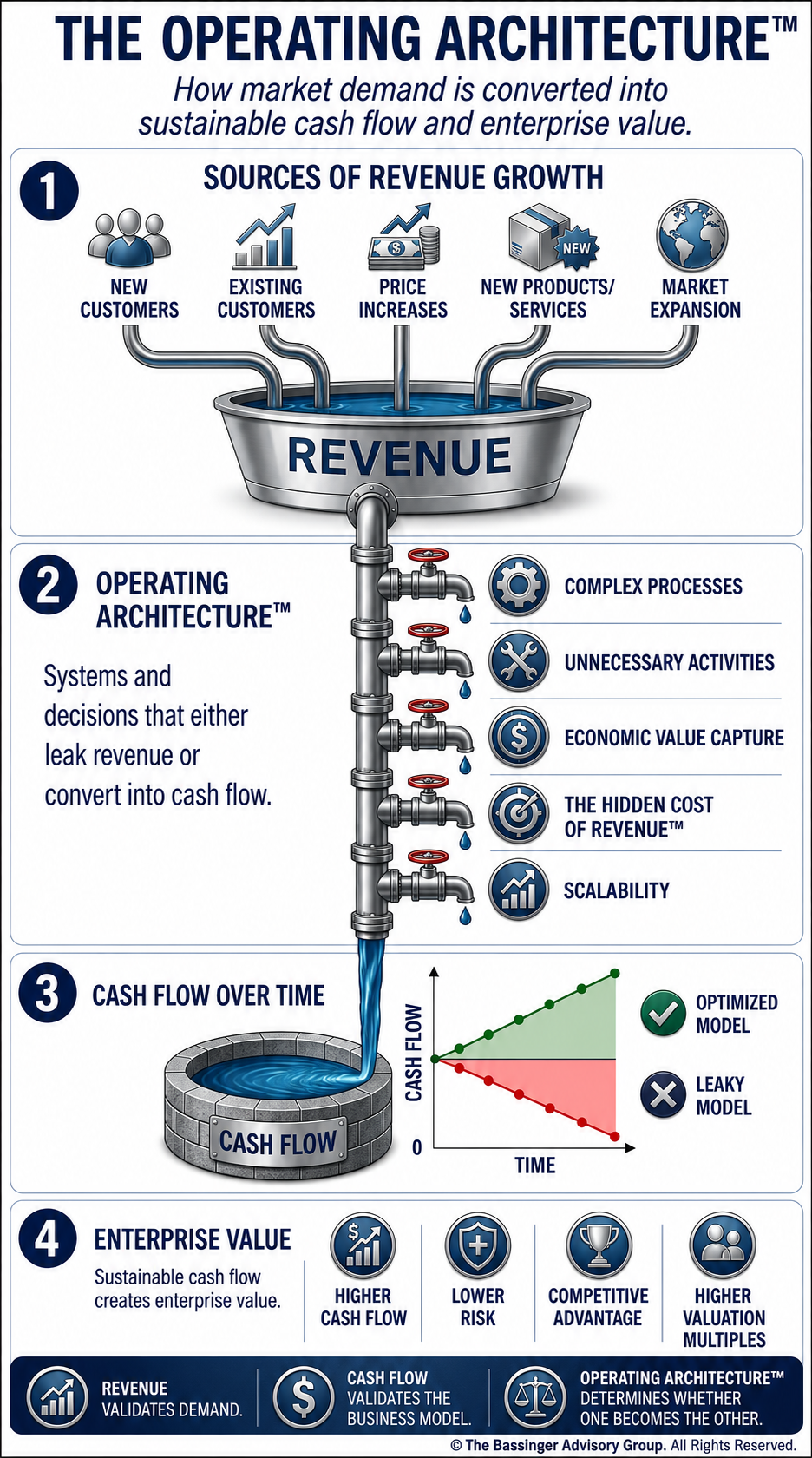
Revenue validates demand. Cash flow validates the business model.
Revenue is visible, measurable, and celebrated. It signals momentum. It can also deceive.
Companies are not valued for revenue alone, but for the confidence that revenue will ultimately produce sustainable cash flow. That is why two companies with similar revenue, products, and market opportunity can command very different enterprise values. One converts demand into cash efficiently. The other consumes cash managing its own complexity.
Growth does not fix an inefficient operating model. It magnifies it. Operating Architecture™ exposes the activities, decisions, handoffs, costs, and constraints beneath the scorecard that determine whether value is converted or lost.
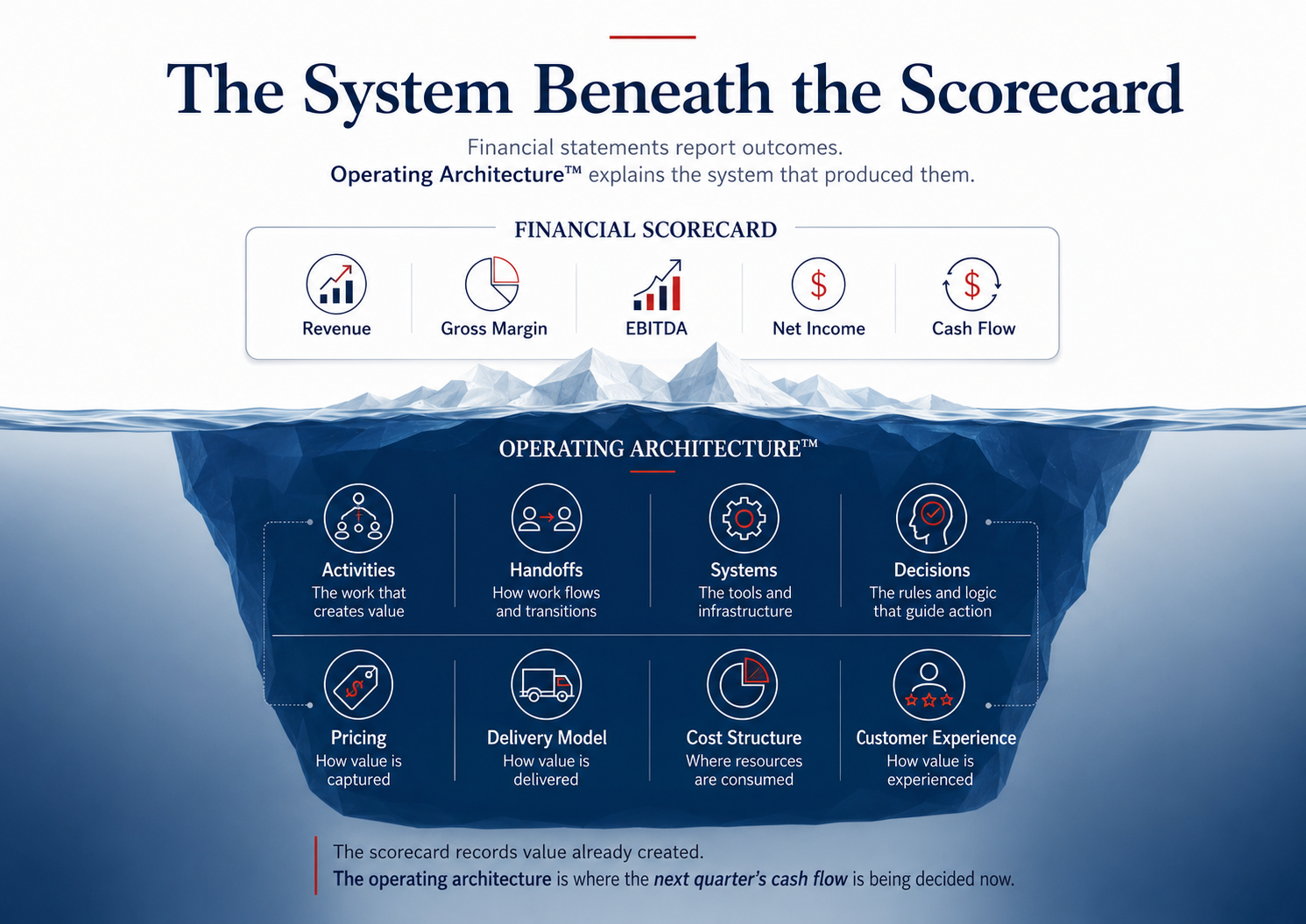
Financial statements report performance. Operating architecture creates it.
The financial scorecard is a rearview mirror—it records outcomes already produced. The operating architecture is where the next quarter’s cash flow is being decided right now.
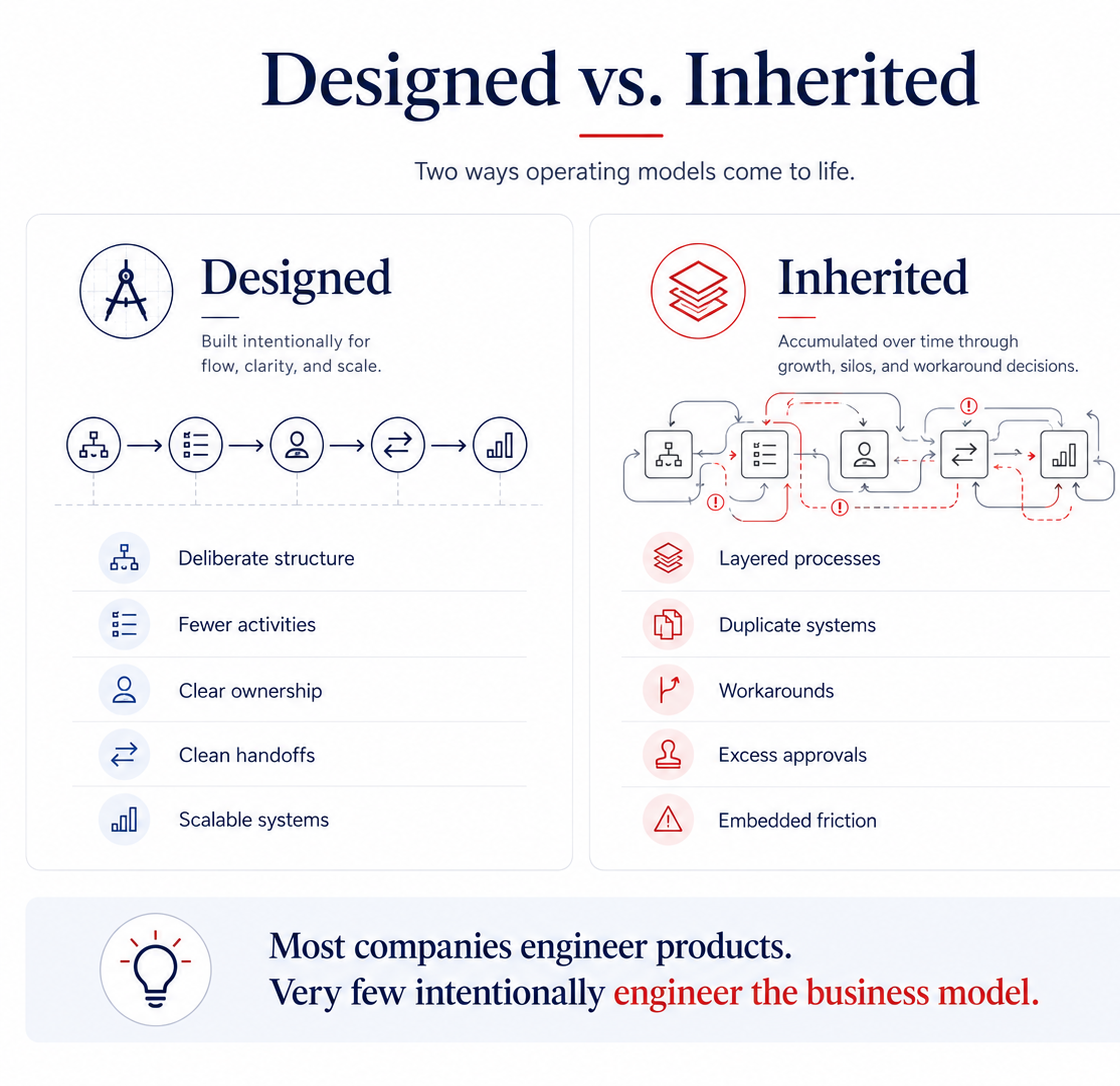
Every product is engineered. Almost no business model is.
In product design, a discipline called DFMA forces every component to justify its existence: Can it be eliminated? Combined? Simplified? Less complexity means lower cost, higher quality, and a stronger platform for scale.
Most businesses suffer from the same problem as poorly designed products—except no one designed them at all. Operating models are inherited, not engineered. They accumulate over years of growth: silos form around functions, reports outlive the people who read them, approvals outlive the risks that created them, manual workarounds become permanent processes, and new systems are added without removing the work they were supposed to replace.
Each activity looks insignificant on its own. Collectively, they become friction—organizational weight. And organizational weight is expensive: it makes growth harder, slower, and less profitable, and it quietly drains cash flow long before it ever shows up on the scorecard.
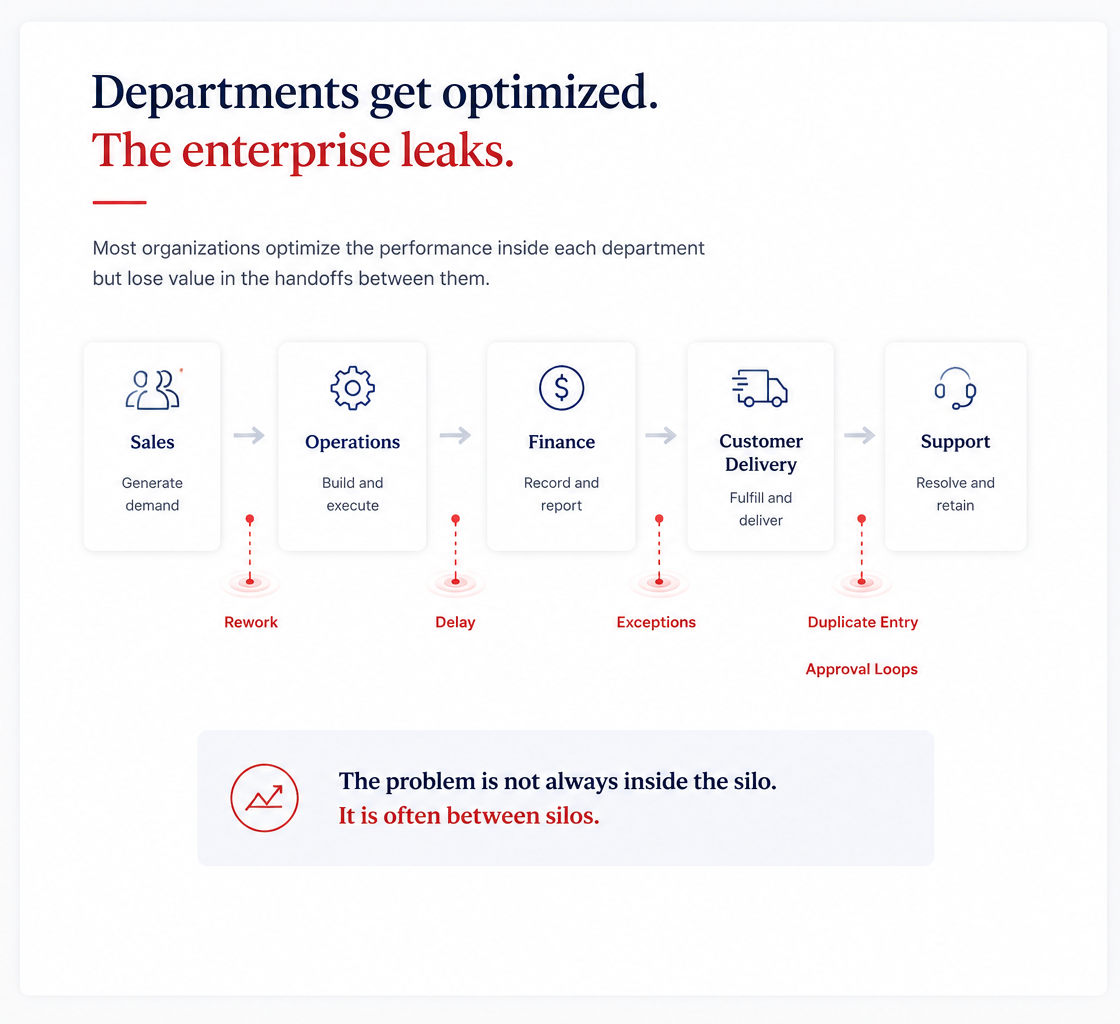
Departments get optimized. The enterprise leaks.
Most improvement efforts optimize departments in isolation. But customers, costs, and cash flow move across the enterprise—through the handoffs, approvals, exceptions, and transitions between functions. Value doesn’t just leak inside departments. It pours out between them.
That is why Operating Architecture™ maps activities across the enterprise rather than within functions—because the business converts demand into cash as one system, not as a collection of departments.
The business converts demand into cash as one system.
Market Demand
The customer need, value proposition, channel, and willingness to pay.
Operating Architecture™
The activities, workflows, systems, decisions, and handoffs used to deliver value.
The Hidden Cost of Revenue™
The true enterprise cost required to acquire, onboard, serve, support, and deliver customer outcomes.
Design for Cash Flow™
The deliberate redesign of the operating and business model to improve conversion.
Enterprise Value
The result of stronger cash flow, scalability, operating leverage, and durable growth.
Five steps to redesign the business system.
Define the Value Proposition
Clarify the customer outcome, willingness to pay, and value the business is designed to deliver.
Map Activities Across the Enterprise
Trace the work, decisions, systems, and handoffs required to acquire, onboard, serve, support, and deliver.
Apply DFMA Thinking
Test every activity: does it create value, reduce risk, or merely exist? Eliminate, combine, and simplify.
Quantify The Hidden Cost of Revenue™
Use activity-based costing to reveal the total economic burden of delivering the customer outcome.
Design for Cash Flow™
Redesign the operating and business model so more demand converts into sustainable cash flow and enterprise value.
Questions leaders should ask—and mistakes they should avoid.
The framework becomes practical when leadership teams stop accepting inherited systems as fixed and begin asking whether the business is intentionally designed to convert demand into cash flow.
Five questions leaders should ask.
Do you know your true Hidden Cost of Revenue™?
Could you redesign your business from scratch?
Do your activities create value, reduce risk, or merely exist?
Are you measuring the right outcomes?
Is your organization built to scale—or simply to survive?
Five mistakes organizations should avoid.
Treating Operating Architecture™ as cost reduction.
Optimizing processes instead of value delivery.
Letting perfect become the enemy of progress.
Underestimating organizational and cultural resistance.
Treating it as a one-time project.
This is the summary. The full argument goes deeper.
Capital can temporarily hide inefficiency. Revenue can temporarily mask it. But every business eventually confronts the economics of its operating model—either by design or by crisis.
The complete Operating Architecture™ white paper—Revenue Is Opinion. Cash Flow Is Truth.—develops the methodology, principles, and case study in full.